日元

Blog

Driving in Japan: The Importance of Yielding to Emergency Vehicles

When you rent a car and drive in Japan, you may encounter emergency vehicles such as ambulances, fire trucks, or police cars with their sirens blaring and red lights flashing. Knowing exactly how to react is crucial not only for the safety of everyone on the road but also to comply with the Japanese Road Traffic Act. Many foreign drivers feel anxious when they hear a siren in an unfamiliar country. However, by understanding a few straightforward rules, you can confidently and safely yield the right of way, ensuring that emergency responders reach their destinations without delay.

What the Japanese Road Traffic Act Requires

In Japan, traffic flows on the left side of the road. This fundamental rule also dictates how drivers should behave when an emergency vehicle approaches. According to Article 40 of the Road Traffic Act, your required action depends entirely on your current location on the road, specifically whether you are near an intersection or driving on a straight stretch of road.

It is important to note that you do not need to slam on your brakes the moment you hear a siren. Instead, remain calm, check your mirrors to locate the approaching emergency vehicle, and follow the specific yielding procedures based on your surroundings.

How to Yield at or Near an Intersection

Intersections are the most critical areas when emergency vehicles are approaching, as they pose the highest risk of collisions. If you are driving at or near an intersection and notice an emergency vehicle approaching, you must follow these specific steps:

  • Do not enter the intersection: If you have not yet entered the intersection, stay out of it. If you are already inside the intersection, exit it safely and promptly.
  • Pull over to the left: Steer your vehicle as far to the left side of the road as safely possible.
  • Come to a complete stop: You must stop your vehicle temporarily to allow the emergency vehicle to pass through the intersection safely.

There is one exception to the "pull over to the left" rule at intersections. If you are driving on a one-way street and pulling over to the left would actually obstruct the emergency vehicle's path, you are required to pull over to the right side of the road instead. Always prioritize creating a clear path for the emergency responders.

How to Yield on Straight Roads and Other Areas

If you are driving on a regular road, away from any intersections, the rules are slightly different but equally important. When an emergency vehicle approaches from behind or from the opposite direction on a narrow road, you must take the following action:

  • Pull over to the left: Move your vehicle to the left side of the road to create space.
  • Yield the right of way: You must give way to the emergency vehicle. While a complete stop is not strictly mandated by law in every non-intersection scenario, slowing down significantly or stopping is often the safest and most practical way to ensure the emergency vehicle can pass safely, especially on narrow Japanese streets.

Just like at intersections, if you are on a one-way street where moving left would block the emergency vehicle, you should move to the right side to clear the path.

Practical Tips for a Safe Reaction

When you hear a siren, your first reaction should be to stay calm. Abrupt braking or sudden lane changes can cause accidents and hinder the emergency vehicle's progress. Use your rearview and side mirrors to identify where the siren is coming from. Once you have located the emergency vehicle, use your turn signals to indicate your intention to pull over, allowing other drivers to anticipate your movements.

In Japan, you will often hear emergency vehicle personnel using a loudspeaker to thank drivers for their cooperation or to provide specific instructions, such as "Please stop on the left." Following these polite instructions ensures a smooth flow of traffic and helps save lives. By familiarizing yourself with these yielding rules, your road trip in Japan will be both safe and enjoyable.

Side-view mirror shows a street scene with an ambulance directly behind the car on a sunny day.

Why Railway Level Crossings Need Extra Care

A rental car gives you the freedom to explore Japan beyond train stations and city centres. It also means learning road rules that may feel unfamiliar. Railway level crossings are one of the most important examples. They appear on both urban streets and quiet rural roads, and a driver must approach each one with care.

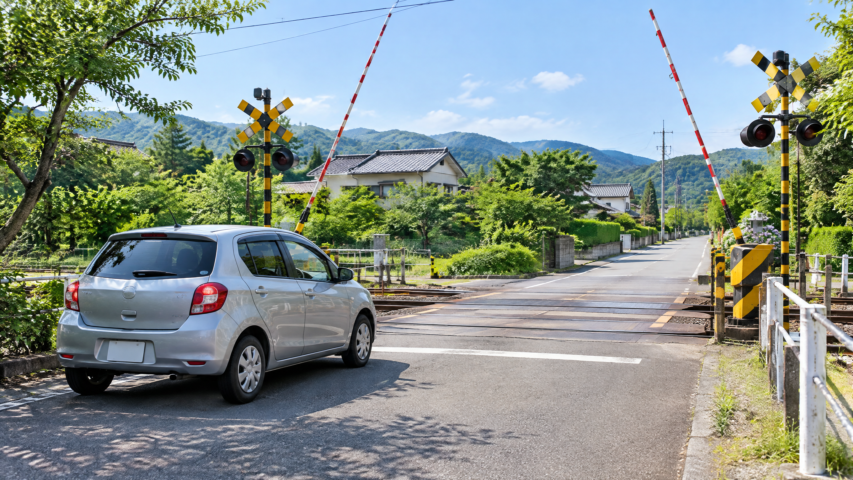
Japan's Road Traffic Act requires a vehicle to stop immediately before a railway crossing, or before its marked stop line, and to check that it is safe before going over the tracks. This rule applies even when the barrier is open and no train is visible. Treat a crossing as a separate safety check, not simply as another part of the road ahead.

The Stop, Look, and Check Routine

Use the same deliberate routine every time you reach a crossing. Slow down early, stop fully, and give yourself a few seconds to assess the situation. If you are driving with passengers, it can help to reduce conversation and music before the crossing so that everyone can concentrate.

  • Stop at the right point: Bring the car to a complete stop immediately before the crossing or the painted stop line. A rolling stop is not enough.
  • Check both directions: Look carefully to the left and right for an approaching train. Listening matters too, especially on a narrow road where your view is partly blocked.
  • Confirm your exit: Before you move, make sure the road beyond the tracks has enough clear space for your whole vehicle. Do not enter if queuing traffic could leave you stopped on the rails.
  • Cross in one movement: Once the way is clear, drive smoothly across. Do not pause, park, or turn around inside the crossing.

There is a limited legal exception. When a normal road traffic signal at the crossing directs vehicles to proceed, you may follow that signal without making the usual stop. Even then, remain alert for obstacles and never assume that a green signal removes the need for careful driving.

When Alarms or Barriers Begin to Operate

Japanese crossings use audible alarms, warning lights, and barriers to protect rail traffic. Never enter the crossing when the alarm is sounding, when lights are warning of a train, or when the barrier is closing or already closed. This is not a situation where it is safe to hurry through before the barrier reaches the road.

If the alarm begins while your car is already inside the crossing, continue forward and leave the crossing as quickly and safely as conditions allow. Do not stop on the tracks. The official guidance from JR-West gives the same practical instruction: move out of the crossing promptly if you hear the bell while you are inside it.

If Your Vehicle Cannot Move

A stalled vehicle on a crossing is an emergency. Most crossings have an emergency notification button close to the warning equipment. If your vehicle cannot move from the tracks, press that button immediately. The button sends a danger signal to approaching trains; then use the contact number displayed beside it to report what has happened.

  • Warn the railway first: Use the emergency button or another available emergency method without delay.
  • Prioritise people: Move yourself and your passengers away from the crossing to a safe place.
  • Report the incident: Follow the contact instructions at the crossing and, if needed, call the police on 110.

These steps are simple, but they are essential. By stopping, checking, and never entering a crossing without a clear exit, you can make your Japan rental-car journey safer and more relaxed for everyone sharing the road and railway network.

White SUV waiting at a rural railroad crossing with yellow-black striped gates and signal lights, green fields and blue mountains in the distance.

Why refueling in Japan deserves a little preparation

A rental car makes it easier to reach coastlines, mountain towns, and rural attractions on your own schedule. Refueling is usually straightforward, but the pump controls, Japanese fuel names, payment process, and rental return rules may be unfamiliar. A few checks before leaving the rental counter can prevent delay and, more importantly, help you avoid putting the wrong fuel in the vehicle.

Confirm the fuel before you drive away

Japanese stations normally offer regular unleaded gasoline, high-octane gasoline, and diesel. Never assume that every rental car uses regular gasoline. Check the rental agreement, the vehicle information supplied at pickup, or the label near the filler opening. If anything is unclear, ask the rental staff before departure. Toyota Rent a Car warns that using the wrong fuel can cause a breakdown, so do not rely only on the nozzle position or your experience with a different car.

  • Regular unleaded: Used by many ordinary passenger cars.
  • High-octane: Required by some models; use it only when specified.
  • Diesel: Used by certain vans, SUVs, and passenger vehicles; it is not gasoline.

Choose full-service or self-service

Japan has both attendant-operated and self-service gas stations. At a full-service station, stop where directed, switch off the engine, and tell the attendant the fuel and quantity. “Regular, man-tan” means regular gasoline, full tank. You may also request a number of liters or a yen amount.

At a self-service station, park with the filler opening beside the pump and follow the screen. The exact sequence varies, but the usual flow is to select a payment method, select the fuel, choose a full tank or a fixed amount, and then refuel. Some machines offer an English menu. If you cannot confirm the correct button, use the station intercom or ask an attendant rather than guessing.

Follow the safety sequence

Turn off the engine, close the doors and windows as instructed, and keep cigarettes and all flames away. Before opening the fuel cap, touch the station’s static-electricity discharge pad. Japan’s Fire and Disaster Management Agency requires safety notices at self-service stations and specifically highlights engine shutdown, fire prevention, and static-electricity precautions. Idemitsu’s self-service guidance also tells customers to discharge static electricity before handling the nozzle.

Open the filler cover, remove the cap, insert the correct nozzle fully, and hold the lever. The pump should stop automatically when the selected amount is reached or the tank is full. Do not continue after automatic shutoff, because forcing in more fuel can cause a spill. Return the nozzle, tighten the cap, close the filler cover, and collect the receipt.

Prepare cash and understand change

Credit cards are accepted at many stations, but not every station accepts every card, and some locations may require cash. Carrying enough Japanese yen is a sensible backup, especially outside major city centers. At some prepaid pumps, cash change is returned at a separate machine by scanning the barcode on the receipt. Read the on-screen message and keep the receipt until the transaction is complete.

Plan the final stop before returning the car

Fuel return conditions differ by rental company and contract, so follow the instructions given at pickup. Some companies require a full tank from a station near the return branch and ask to see the final receipt. Nippon Rent-A-Car, for example, publicly instructs customers to refuel near the return location and present the receipt. If you cannot refuel, the company may calculate a charge using its own mileage or fuel-gauge method, which may cost more than filling the tank yourself.

Before a long rural drive, identify practical fuel stops and check current opening information rather than waiting for the warning light. Save the rental company’s contact number, verify the fuel type once more, and allow extra time for the final refueling stop. With these simple habits, refueling becomes a routine part of the journey rather than a stressful surprise.

Official information

For operating details, consult the public refueling guidance from Toyota Rent a Car, the Idemitsu self-service guide, and the safety notice from Japan’s Fire and Disaster Management Agency.

Man refueling a white sedan at a gas station with blue sky and mountains in the background

What to Do First After an Accident or Breakdown

If you are involved in a traffic accident or your rental car breaks down while driving in Japan, the very first priority is to ensure safety. Stop your vehicle in a safe location immediately, turn on the hazard lights, and place warning triangles or flares behind your car to alert approaching drivers. Under no circumstances should you negotiate a private settlement on the spot, as doing so will render you ineligible for insurance and compensation benefits provided by your rental car company. Many foreign tourists unknowingly void their coverage by skipping official procedures. Taking the correct initial steps protects both your safety and your wallet during your Japanese road trip.

Mandatory Police Notification (Dial 110)

According to the National Police Agency of Japan, you must report all traffic accidents to the police by dialing 110. This rule applies strictly even to minor collisions, scratches, or single-car accidents where no one is visibly injured and no other vehicle is involved. The police will investigate the scene and issue a traffic accident certificate. This certificate is an essential, legally required document for processing any insurance claims with your rental provider. Failing to report the incident to the police is a direct violation of the Road Traffic Act. Without the police report, the rental company will charge you for the full repair costs out of pocket, regardless of the insurance package you purchased.

Medical Emergencies and Ambulance (Dial 119)

If anyone is injured in the accident, you must administer first aid to the extent possible and immediately dial 119 to request an ambulance. Do not move the injured party unnecessarily unless they are in immediate danger from oncoming traffic or a potential vehicle fire. Once the ambulance is called and medical help is on the way, you must still dial 110 to notify the police about the accident. An emergency phone call can be made free of charge from any phone, including public pay phones located across Japan. Emergency operators often have access to multilingual interpretation services to assist foreign drivers.

Special Procedures on Expressways

Experiencing a breakdown or accident on a Japanese expressway requires extreme caution due to the high speed of traffic. Move your vehicle to the shoulder or a sufficiently wide safe space if possible. Turn on the hazard lights and place the warning triangle behind the vehicle. All passengers must evacuate the vehicle and move outside the guardrail or to a safe location immediately. Never stay inside the car or walk on the expressway lanes, as secondary accidents are highly fatal. You can use your mobile phone or the emergency telephones located every 1 kilometer (or every 200 meters inside tunnels) to contact the road management center or the Japan Automobile Federation (JAF).

Contacting Your Rental Car Company

After securing the site and contacting the police (and ambulance if necessary), you must notify your rental car company. Most major rental companies in Japan operate a 24-hour accident and roadside assistance customer center with multilingual support. Follow their specific instructions regarding towing, vehicle replacement, and further procedures. Remember that an excess fee and a Non-Operation Charge (NOC) may apply depending on the insurance coverage you selected at the time of rental. Do not abandon the vehicle or arrange unauthorized towing services.

Summary of the Emergency Checklist

To ensure a smooth resolution to unexpected road emergencies in Japan, keep this checklist in mind:

  • Secure the area and prevent secondary accidents using hazard lights and warning triangles.
  • Evacuate to a safe place, especially on expressways, moving behind guardrails.
  • Dial 119 for an ambulance if there are any injuries.
  • Dial 110 to report the accident to the police, regardless of severity.
  • Contact your rental car company's emergency hotline for roadside assistance.

By strictly following these official guidelines, you can navigate stressful situations safely and ensure your insurance coverage remains valid throughout your journey in Japan.

Rental car safely stopped on a Japanese expressway shoulder with warning triangle and travelers behind the guardrail

Driving a rental car across Japan is an incredible way to explore the country. However, navigating the expressways and understanding the toll system can seem overwhelming. The Electronic Toll Collection (ETC) system is the most efficient way to handle highway tolls. This guide covers the essential information you need regarding ETC cards, toll gate procedures, and how to safely manage unexpected situations.

Understanding the ETC System and Your Rental Car

The ETC system allows drivers to pass through highway toll gates without stopping to pay manually. The system uses wireless communication between an in-vehicle device and antennas at the gates. When you rent a car in Japan, the vehicle will almost always have the device installed. However, the ETC card itself must be requested separately.

  • Requesting an ETC Card: Always check the availability of ETC cards when making your reservation. Most rental companies offer them for a small daily fee. Request it early, as supplies can be limited.
  • Checking Card Insertion: Before starting, make sure the ETC card is fully inserted in the correct direction. An indicator will confirm the system is ready. A correctly inserted card is vital; otherwise, the gate will not open.
  • Exploring Expressway Passes: If covering long distances, inquire about regional fixed-rate passes. These are loaded onto your rental ETC card and offer significant savings.

Navigating Highway Toll Gates Safely

Approaching a toll gate requires attention to overhead signs indicating accepted payment methods. There are three types of lanes: ETC dedicated, General, and Shared. Choosing the right lane early is crucial.

  • ETC Lanes (Purple Signs): Exclusively for vehicles with a valid ETC card. Slow down to 20 km/h or less. Maintain a safe distance and proceed slowly. The gate bar opens automatically. Never speed through.
  • General Lanes (Green Signs): If you lack an ETC card, use the "一般" (General) lanes. At the entrance, stop completely to take a paper ticket. At the exit, hand the ticket to the attendant or machine, and pay using Yen cash or credit card.
  • Shared Lanes (Purple and Green): Accept both ETC and general payments. ETC vehicles pass slowly, while non-ETC vehicles must stop. Exercise caution, as the vehicle ahead may stop unexpectedly.

Handling ETC Gate Errors Safely

Occasionally, the gate bar may fail to open due to an improperly inserted card or communication error. Handle this calmly to prevent accidents.

  • Never Reverse Your Vehicle: If the bar stays down, stop immediately. Never attempt to reverse, as this can cause a serious collision. Reversing on a highway is extremely dangerous and strictly prohibited.
  • Turn on Hazard Lights: Warn approaching vehicles by turning on your hazard lights immediately after stopping.
  • Call for Assistance: Use the intercom located near the gate to contact staff. Do not exit your vehicle. Wait for instructions.

Understanding Smart Interchanges (Smart IC)

You may encounter "Smart ICs" on your navigation system. These are special interchanges often located at service areas to improve local access.

Smart ICs are strictly for ETC vehicles. There are no general lanes or staff to collect cash. Without an ETC card, you cannot enter or exit using a Smart IC and must route through standard interchanges.

By understanding how to rent an ETC card, choosing the correct lane, and managing gate issues, you can navigate Japan's expressways confidently. Always adhere to the 20 km/h speed limit at ETC gates.

Silver car approaching a toll plaza with multiple lanes and green hills in the background, on a sunny day with a blue sky.

Driving in Japan During Summer: What You Need to Know

Summer in Japan offers vibrant festivals, lush green landscapes, and the freedom of the open road. However, it also brings extreme heat and sudden, intense rainstorms. Whether you are navigating the scenic countryside or traveling between cities, understanding how to handle these seasonal weather conditions is crucial for a safe and enjoyable road trip.

Protecting Against Extreme Heat

The summer heat in Japan can be unforgiving, with temperatures often exceeding 35°C (95°F). The Japan Automobile Federation (JAF) has conducted extensive tests showing how quickly a vehicle's interior can become dangerous. According to their research, when a car is parked in the sun on a 35°C day with the air conditioning turned off, the interior temperature can reach a life-threatening level in just 15 minutes. The dashboard can become hot enough to cause burns, and the overall heatstroke risk becomes severe.

To protect yourself and your passengers, never leave children, elderly individuals, or pets in a parked car, even for a short errand. When parking, try to find a shaded area or an indoor garage. Using a sunshade on the windshield can help reduce the dashboard temperature, but it will not prevent the cabin from heating up dangerously. Always ensure your vehicle's air conditioning is functioning properly before starting your journey, and stay hydrated by keeping plenty of drinking water in the car.

Navigating Heavy Rain and Slippery Roads

Summer is also the season for sudden downpours and typhoons. Driving in heavy rain requires a different set of skills and heightened awareness. JAF warns that when rain first begins to fall, it mixes with dust and oil on the road, making the surface exceptionally slippery. During these times, it is vital to reduce your speed, especially before entering curves, and avoid sudden braking or sharp steering.

Visibility is another major concern during a downpour. Always turn on your headlights to ensure other drivers can see you. Because braking distances increase significantly on wet roads, you should maintain a much larger following distance than you would in dry conditions. Before you set out, check your rental car's tires; worn tires are far more likely to lose traction and hydroplane, a dangerous condition where the tires glide on a layer of water, resulting in a total loss of steering and braking control.

Avoiding the Dangers of Flooded Roads

Heavy rain can quickly lead to localized flooding, especially in low-lying areas or underpasses. The Ministry of Land, Infrastructure, Transport and Tourism (MLIT) strictly advises against driving through flooded roads. Vehicles are not designed to operate in deep water. If the water level reaches the floor of the car, water can enter the engine or electrical systems, causing the vehicle to stall permanently.

Furthermore, if the water level rises to the bottom of the doors, the external water pressure makes it extremely difficult to open the doors from the inside. If the water reaches halfway up the door, opening it becomes nearly impossible. If you encounter a flooded road, turn around and find an alternate route. Never attempt to cross it. If your vehicle does become stalled in rising water, unbuckle your seatbelt and evacuate immediately before the water pressure traps you inside.

Staying Informed and Prepared

Preparation is your best defense against summer weather hazards. Before hitting the road, check the latest weather forecasts and warnings. The Japan Meteorological Agency (JMA) issues specific advisories for heavy rain and strong winds, and warnings when serious disasters are possible. These updates are accessible in multiple languages and should be monitored daily.

Always listen to the guidance provided by your rental car company and familiarize yourself with the vehicle's emergency equipment, such as hazard lights and escape tools. By respecting the heat, adjusting your driving for the rain, and avoiding flooded areas, you can ensure your summer road trip in Japan remains a memorable and safe adventure.

Gray sedan driving on a wet rural road beside a grassy canal, with green hills and a cloudy sky in the distance.

Top 5 Scenic Drives in Hokkaido for Your Next Road Trip

Hokkaido, Japan's northernmost island, is a paradise for road trip enthusiasts. With its vast landscapes, pristine nature, and well-maintained highways, it offers some of the most breathtaking driving experiences in the country. Whether you're a nature lover, photography enthusiast, or simply seeking adventure, these five scenic drives will transform your Hokkaido vacation into an unforgettable journey.

1. Furano and Biei: Patchwork Hills and Flower Fields

The roads between Furano and Biei wind through rolling farmland, colorful flower fields, and the dramatic Tokachidake mountain range. Summer brings lavender and vivid seasonal blooms, while autumn turns the fields gold. Follow the Patchwork Road and Panorama Road, and stop only at designated parking areas to protect local farms. Allow 3-4 hours for a relaxed circuit with photo stops, cafés, and short walks.

2. The Shiretoko Peninsula Loop: Coastal Wilderness

Located in northeastern Hokkaido, the Shiretoko Peninsula offers one of Japan's most remote and pristine coastal drives. This UNESCO World Heritage site features dramatic cliffs, pristine beaches, and dense forests. The loop drive takes approximately 2-3 hours and rewards drivers with stunning ocean vistas and opportunities to spot wildlife. Summer is the ideal season for this drive, as winter weather can make conditions challenging. Don't miss the scenic viewpoint at Shiretoko Pass, which offers sweeping views of the coastline and Sea of Okhotsk.

3. Lake Toya Scenic Route: Volcanic Beauty

This picturesque drive circles Lake Toya, a caldera lake surrounded by volcanic mountains and charming towns. The approximately 50-kilometer route takes 1-2 hours and offers numerous pullouts for photos and exploration. Stop at hot spring resorts along the way to enjoy traditional onsen experiences. The lake is particularly beautiful during spring cherry blossom season and autumn foliage. The lakeside observatories and roadside parks provide excellent photo opportunities, while sightseeing boats offer closer views of Nakajima Island.

4. Daisetsuzan National Park Scenic Byway: Alpine Splendor

Hokkaido's largest national park offers an incredible driving experience through Japan's most extensive alpine region. The scenic byway winds through dense forests, past crystal-clear streams, and up to high-altitude viewpoints. Summer and early autumn are optimal seasons, with the road typically open from May through October. The drive showcases dramatic mountain scenery, including the iconic Asahidake peak. Plan for at least 3-4 hours to fully appreciate the landscape and make stops at hiking trailheads and scenic overlooks.

5. Otaru to Shakotan: The Blue Coast

This coastal route runs from the historic port of Otaru toward the Shakotan Peninsula along the Sea of Japan. Expect rugged cliffs, fishing villages, turquoise water, and viewpoints near Cape Kamui. The journey is roughly 80 kilometers and takes about two hours without stops, but a half-day is better for seafood lunches and coastal walks. Summer offers the clearest colors; in winter, confirm road and weather conditions before departure.

Essential Tips for Your Hokkaido Road Trip

  • Rent a reliable vehicle: Choose a car suited to seasonal conditions and road types
  • Plan ahead: Check road conditions and weather forecasts before departing
  • Allow extra time: Hokkaido's distances are vast; don't rush your journey
  • Carry supplies: Gas stations and restaurants can be sparse in remote areas
  • Respect wildlife: Hokkaido is home to bears and deer; drive cautiously, especially at dusk

Experience Hokkaido with Relax Rentacar

Ready to explore Hokkaido's stunning scenic drives? Relax Rentacar offers a wide selection of well-maintained vehicles perfect for your road trip adventure. From compact cars for city exploration to spacious SUVs for mountain terrain, we have the ideal vehicle for your journey. Our rental locations throughout Hokkaido provide convenient pickup and drop-off options, and our knowledgeable staff can recommend the best routes based on your interests and travel dates. Book your rental today and discover why Hokkaido is one of Japan's premier road trip destinations.

Car driving along a coastal mountain road with blue sea on the left and green hills on the right under a clear sky

Discover Hokkaido's Best Scenic Drives with Relax Rentacar

Hokkaido, Japan's northernmost island, is renowned for its breathtaking natural landscapes, diverse seasons, and serene countryside. One of the best ways to truly experience the island's beauty is by taking a road trip along some of its most scenic routes. Whether you're visiting in spring to see vibrant flower fields, in summer for lush greenery, or in winter for snow-covered panoramas, Hokkaido offers remarkable drives that showcase its unique charm.

At Relax Rentacar, we provide reliable and comfortable car rentals to help you explore these routes at your own pace. Here are the top five scenic drives in Hokkaido that you don't want to miss on your next adventure.

1. Shiretoko Pass Road

The Shiretoko Pass Road winds through the Shiretoko Peninsula, a UNESCO World Heritage site known for its rich nature and wildlife. This drive offers spectacular mountain views, dense forests, and the chance to spot rare animals such as brown bears and deer. The road connects Rausu and Shari, with numerous lookout points where you can stop and savor panoramic views of the Sea of Okhotsk.

2. Niseko Panorama Line

Niseko is famed for its powder snow in winter, but the Niseko Panorama Line is a stunning drive throughout the year. This route meanders up mountainous slopes, offering sweeping vistas of Mount Yotei—often called the "Mount Fuji of Hokkaido"—and rolling farmland. During summer and autumn, the forests along the route explode with vibrant colors, making it a perfect spot for photography enthusiasts.

3. Biei Patchwork Road

One of Hokkaido’s most iconic routes, the Biei Patchwork Road is a gateway to the colorful farmlands that stretch across the region. Named after the patchwork-like patterns created by fields of flowers and crops, this route is particularly mesmerizing during the lavender blooming season in July and the golden hues of autumn. Don’t forget to stop by the famous “Blue Pond,” a surreal, turquoise water body nearby.

4. Furano to Asahikawa via Route 237

This route links the charming towns of Furano and Asahikawa, combining flower fields, rolling hills, and cultural landmarks. Furano’s flower farms bloom spectacularly during summer, while Asahikawa offers urban comforts and the renowned Asahiyama Zoo. The drive along Route 237 includes charming stops such as Ningle Terrace, a quaint crafts village surrounded by nature.

5. Lake Toya Skyline

For lake lovers, the Lake Toya Skyline provides an unforgettable drive with views circling around the beautiful caldera lake. The route features lookout spots atop Mount Usu, where you can overlook volcanic landscapes and the calm, azure waters of Lake Toya. The journey combines adventure with relaxation, perfect for those who wish to balance sightseeing with nature exploration.

Tips for Driving in Hokkaido

  • Renting a Car: Choose a reliable rental service like Relax Rentacar to ensure a smooth, stress-free journey with vehicles suited to Hokkaido’s roads and weather.
  • Seasonal Preparation: Winter driving requires snow tires and experience handling icy conditions; our vehicles come equipped with winter gear when needed.
  • Navigation: Use a GPS system or a navigation app compatible with Japanese locations to avoid getting lost in remote areas.
  • Fuel & Facilities: Plan your stops carefully, as gas stations can be sparse in some rural regions.

Exploring Hokkaido by car unlocks a world of stunning natural beauty and cultural experiences. With Relax Rentacar, your journey will be comfortable, flexible, and memorable. Ready to start your scenic drive? Book your car today and embark on an unforgettable road trip through Hokkaido!

White SUV driving along a winding road through purple lavender fields with a mountain in the distance at sunset.

Exploring Rural Japan by Car: Hidden Gems

Driving through Japan's countryside is one of the most rewarding ways to discover small towns, secret coastlines, and seasonal landscapes that never make the guidebook front page. With a rental car you control the pace, choose when to stop for roadside soba or a viewpoint, and reach places public transport rarely serves. This guide covers practical tips, recommended routes, and local etiquette to help you plan a confident and memorable road trip across rural Japan.

Why Self-Driving Works in Rural Japan

Rural Japan offers open roads, scenic byways, and attractions spaced far apart. Trains are reliable but can limit timing and mobility. A car lets you chase early morning mist over rice paddies, linger at quiet shrines, or divert to a mountain onsen. The tradeoff is planning: navigation, toll costs, and parking require attention.

Practical Rental and Driving Tips

  • Driver documentation: Bring an International Driving Permit (IDP) based on the 1949 Geneva Convention or a Japanese translation for certain countries. Always carry your passport and rental contract.
  • Book in advance: Reserve larger vehicles if you need room for luggage or winter gear. Major companies include Toyota Rent a Car, Nippon Rent-A-Car, Times, and local shops in regional airports.
  • Navigation: Rent a car with an English GPS or use Google Maps. Download offline maps and add driving-specific apps. Be aware rural signage can be sparse.
  • ETC card: Ask the rental counter about an ETC device for automatic tolls. It speeds up payment and avoids change hassles at expressway booths.
  • Insurance: Check coverage options and consider supplemental insurance for peace of mind. Note deductibles and whether gravel roads are covered.
  • Seasonal gear: In winter bring or rent winter tires and snow chains. In summer keep water and insect repellent on hand for remote hikes.

Etiquette and Road Rules

  • Drive on the left. Yield to pedestrians and obey local speed limits, which can be lower on narrow rural roads.
  • One-lane roads and agricultural lanes are common. Use passing points and be polite with oncoming drivers.
  • Parking: Look for municipal lots or roadside coin parks. Many small towns charge modest rates; leave parking tickets visible when required.
  • Noise and respect: Keep the car quiet in residential areas and near shrines. Rural communities value low disturbance.

Hidden Gem Routes to Consider

Below are curated routes that reward the curious driver. Times are approximate and depend on stops.

  • Noto Peninsula Loop (Ishikawa): Coastal cliffs, fishing harbors, and Wajima morning market. Great for seafood and sea views.
  • Kiso Valley and Kisoji Route (Nagano): Historic post towns like Tsumago and Magome, cedar forests, and quiet mountain passes.
  • Iya Valley (Shikoku): Dramatic vine bridges, steep gorges, and hot springs off the main tourist trails.
  • San’in Coast and Tsuwano (Shimane): Samurai towns, tidal inlets, and dramatic coastlines with few crowds.
  • Oga Peninsula and Nyuto Onsen (Akita): Rugged coastlines and remote onsen villages perfect for autumn colors and winter solitude.

Local Tips for the Best Experience

  • Stop at roadside stations (michi-no-eki) for local produce, clean toilets, and maps. These hubs are invaluable for rural travel.
  • Plan fuel stops: Some stations close early in remote areas. Fill up when you can.
  • Mix activities: Combine short hikes, onsen, and town walks rather than long single-day drives to savor each stop.
  • Use cash: Smaller shops and rural eateries may not accept cards.

Exploring rural Japan by car is less about speed and more about discovery. With sensible planning and an open mind you'll find hidden shrines, empty beaches, roadside farmers selling persimmons, and moments of unexpected beauty. Drive safely and enjoy the slow, intimate pace of Japan's countryside.

Rural Japanese hillside village at sunset with thatched-roof houses, cherry blossoms, terraced fields, and distant mountains.

Why rent a car in Japan?

Japan rewards the curious driver. Beyond the bullet trains and city subways lie quiet fishing towns, mountain onsens, farm-to-table roadside diners, and coastal roads that turn every bend into a postcard. With a rental car, you can chase sunrise over Mount Fuji, detour for a steaming bowl of ramen when you spot a local favorite, and linger at viewpoints long after the tour buses leave. It’s freedom on your schedule, in a country where roads are safe, signage is clear, and rest stops feel like tiny theme parks.

  • Hokkaido: flower fields, crater lakes, and smooth highways built for big-sky road trips.
  • Fuji Five Lakes: serene shores, forest shrines, and iconic mountain views at your own pace.
  • Setouchi Coast: island-dotted vistas and citrus groves along a sunlit inland sea.
  • Kyushu: volcano routes, steaming onsen towns, and farm roads framed by tea fields.

Licenses, roads, and rules to know

Most visitors will need a 1949 Geneva-format International Driving Permit (IDP), your valid home license, and your passport to rent and drive. Always check current requirements before you travel. Japan drives on the left, seat belts are required for all, and hands-free is mandatory if you use your phone for navigation.

  • Left-side driving: Keep left; slower traffic stays to the left on expressways.
  • Speed limits: typically 30–50 km/h in towns, 60 km/h on ordinary roads, 80–100 km/h on expressways unless posted otherwise.
  • Tolls and ETC: Expressways use tolls. Renting an ETC card lets you pass through dedicated gates and pay later—faster and often cheaper on distance-based discounts.
  • Navigation: Most rental cars offer multilingual GPS. Pin your hotel’s phone number or map code to find it fast.
  • Child seats: Required for children under 6 years old; reserve in advance.
  • Emergency: 110 for police, 119 for fire/ambulance. Pull over safely before calling.

Parking and fueling made simple

Avoid street parking unless clearly allowed. Use coin parking lots marked with a blue “P” or yellow signs; rates and maximums are shown at the entrance. In cities, department stores and attractions often validate parking—ask before you pay. In the countryside, roadside stations (Michi-no-Eki) offer free parking, clean restrooms, local snacks, and produce markets.

Fuel is easy: you’ll see Regular (unleaded), High-octane, and Diesel. Many stations are self-serve; others are full-service with attendants guiding you in. Pay by cash or card, and keep receipts if you need to refuel to a specific level. If in doubt, show the staff your fuel cap or say “Regular, please.”

Seasonal and regional tips

  • Winter driving: In Hokkaido, Tohoku, and mountain regions, rent a car with winter tires or 4WD. Drive gently on ice, leave extra space, and watch for black ice in the shade.
  • Holiday traffic: Golden Week (late Apr–early May), Obon (mid-Aug), and New Year can mean heavy congestion. Start early, use ETC lanes, and build in buffer time.
  • Wildlife and rural roads: Expect deer, foxes, or boar at dawn/dusk. Use low beams in fog and slow before blind curves.
  • Rest stops you’ll love: Expressway Service Areas and Michi-no-Eki have local meals, souvenirs, play areas, and even onsen in some spots.
  • Etiquette: Don’t block driveways, idle engines near homes at night, or park in reserved temple/shrine spaces.

How Relax Rent-a-Car makes it easy

  • Multilingual support and GPS so you can hit the road with confidence.
  • ETC card rental for smooth toll payments and time savings.
  • Clear insurance options and 24/7 roadside assistance for peace of mind.
  • Child seats, snow tires, and phone holders available on request.
  • Convenient locations and flexible one-way rentals on popular routes.

Two easy road trip ideas

  • Fuji Five Lakes Loop (2–3 days): Start near Kawaguchiko, circle the lakes, visit Oshino Hakkai springs, and cap it with a sunset drive to a lakeside onsen.
  • Setouchi Coastal Meander (3 days): From Okayama, trace the inland sea’s viewpoints, sample citrus desserts, and stop at island art sites and fishing ports.

Before you go

Reserve early for peak seasons, add an ETC card, and download offline maps. Pack snacks for scenic pullouts, and keep small coins for rural parking. Then point your compass at the countryside and let the road write your itinerary. When you’re ready, book with Relax Rent-a-Car and drive Japan your way.

White car driving along a winding coastal road lined with cherry blossoms, Mount Fuji visible in the distance on a clear day.