Start with a weather and road check
Rain does not have to cancel a Japanese road trip, but it should change the way you plan it. Before collecting your rental car, check the latest local weather warnings and the route you intend to use. Japan’s Meteorological Agency publishes warnings for heavy rain, landslides, flooding and storm surge, while road operators and navigation services may show closures or restrictions. A route that looked straightforward in the morning can become unsuitable after a short, intense downpour. Build extra time into the day, keep a practical alternative destination in mind, and never treat a closure sign as a suggestion.
At pickup, take one calm minute to find the demister, front and rear wipers, headlight controls and hazard-light switch. Adjust mirrors and seat position before moving off, then enter your destination in the navigation system while parked. The Japan Automobile Federation (JAF) reminds drivers that using a phone or being distracted by a car-navigation system while driving is prohibited. This matters even more in rain, when attention is already needed for changing visibility, pedestrians and standing water.
Reduce speed before the road feels difficult
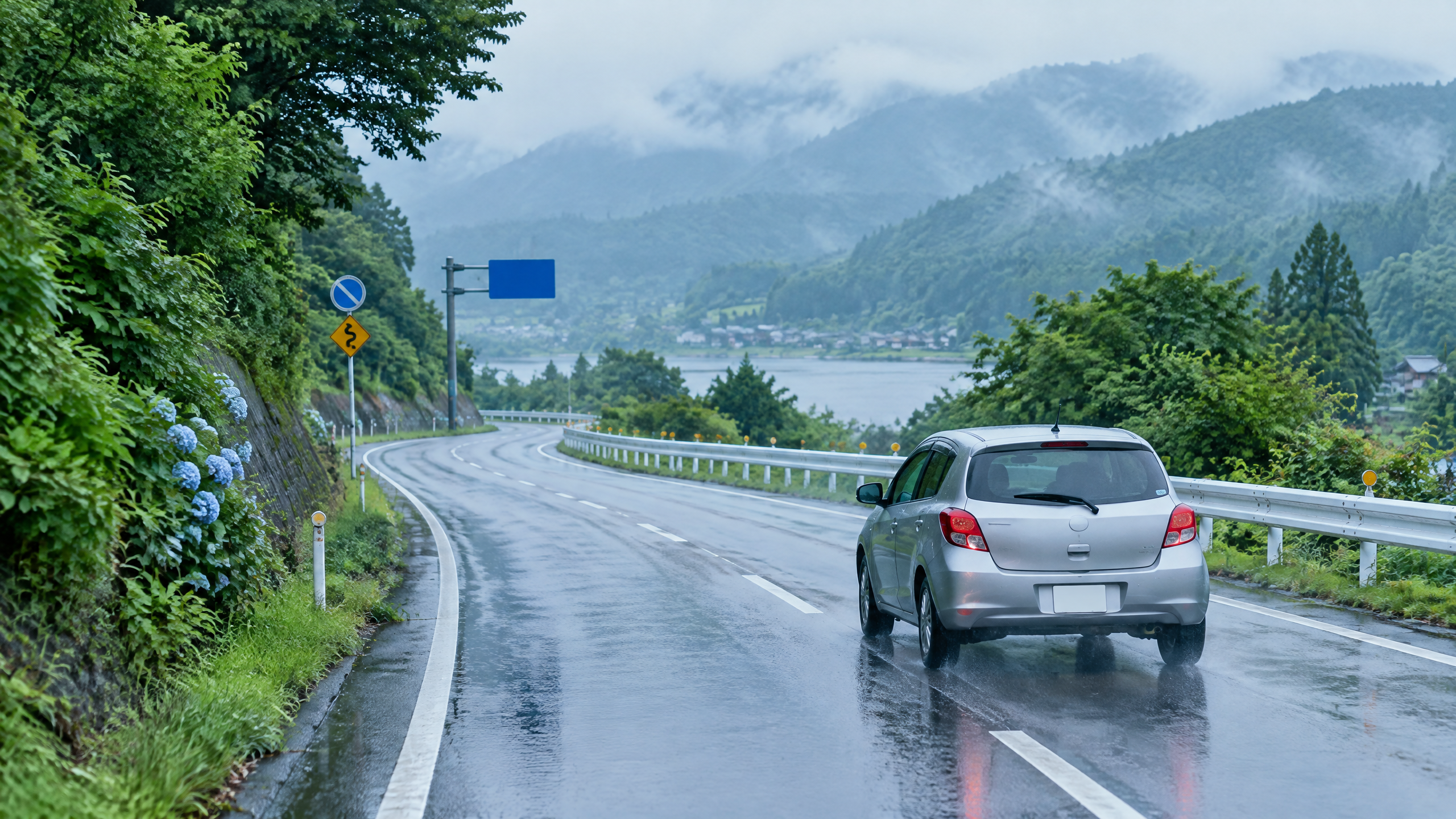
A wet surface can reduce grip and lengthen the distance needed to stop. Rather than waiting for the car to feel unstable, ease off the accelerator early and leave a larger gap to the vehicle ahead. Brake progressively, steer smoothly and avoid abrupt lane changes. This is especially useful when you are still adapting to Japan’s left-side traffic, narrow local streets and unfamiliar right turns across oncoming traffic.
Keep your eyes moving beyond the vehicle in front. In residential streets, rain can hide pedestrians behind umbrellas and make cyclists harder to see. JAF states that drivers must yield to pedestrians, so approach crosswalks and side streets at a speed that lets you stop comfortably. Painted arrows, zebra crossings, metal covers and leaves can all deserve extra care when wet; do not brake sharply or accelerate hard while crossing a slick-looking surface. Follow every posted speed limit. Where no limit is posted, JAF lists 60 km/h for ordinary roads and 100 km/h for expressways for regular-sized cars, but rain, traffic and visibility may require a much lower safe speed.
Make visibility a driving task, not an afterthought
Use the wipers and ventilation or demister early, before the windscreen fogs heavily. Turn on your headlights whenever rain, spray, tunnels or dusk make it harder to see or be seen. Keep the windshield clear inside and out, and avoid relying on high beams in heavy rain because reflected light can reduce what you see. If the view through the glass is poor, pull into a legal, safe place and wait rather than continuing to search for a turn or read a sign at the last moment.
- Keep both hands ready for the wheel when passing larger vehicles, because spray can briefly block your view.
- Use indicators early and give following drivers time to react.
- On an expressway, stay in the driving lane except when overtaking; JAF advises using the passing lane only to pass.
Do not gamble on water or closures
Never assume that a puddle is shallow. Heavy rain can quickly flood low points, including underpasses, and the Ministry of Land, Infrastructure, Transport and Tourism explains that roads may be closed to protect users when water collects. JAF also warns that cars can become submerged after entering a flooded lane during sudden heavy rain or a typhoon. Turn around and use an official detour if water covers the road, the depth is uncertain or barriers, electronic signs or staff direct traffic away.
If conditions worsen, choose the conservative option: delay the journey, stop at a safe staffed facility, or contact your rental company for its instructions. Do not stop on an expressway shoulder except in an emergency. For a breakdown, JAF advises moving the car out of traffic where possible, using hazard lights as appropriate, and getting to a safe place rather than remaining in danger. In an accident, protect the scene, call 119 for injuries and report the incident to police on 110. A slower, shorter day is a successful rainy-day drive when everyone arrives safely.
A simple rainy-day routine
Check warnings and road information, prepare the car controls while parked, slow down early, create more space, make yourself visible and turn back from water or a closure. These habits let you enjoy Japan’s landscapes without turning a changing forecast into an avoidable risk.