Why bicycles deserve a place in your driving plan
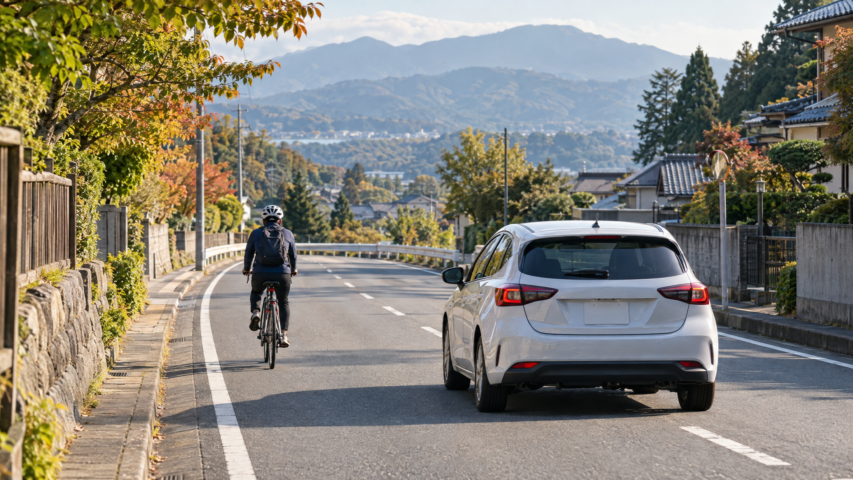
A rental-car trip in Japan often moves between city streets, small towns, coastal roads and rural lanes. On all of them, expect bicycles. Japan’s National Police Agency classifies bicycles as vehicles, and where a roadway and sidewalk are separated, cyclists generally use the roadway and keep to the left. For a visitor used to a different road layout, that means a bicycle may be travelling ahead of you near the left edge rather than on the pavement.
Do not treat that position as an invitation to squeeze past. A cyclist can need room for a drain cover, rough surface, parked vehicle, opening door, gust of wind or a change of direction. Build bicycle awareness into the trip from the start: set the navigation before moving, keep the windscreen and mirrors clear, and leave enough time that no one feels pressed to pass. This small change makes a scenic drive calmer for everyone.
Know the 2026 passing rule before you close the gap
Japan introduced an important road-rule update on 1 April 2026. When a motor vehicle passes on the right of a bicycle travelling in the same direction and there is not sufficient space between them, the driver must proceed at a speed safe for that gap. The National Police Agency’s practical guidance is to make as much room as possible—about one metre is the stated safety guide. If that space cannot be secured, its guidance suggests slowing to around 20–30 km/h, while always adapting to the road, traffic, weather and visibility.
The useful rental-car habit is simple: decide before reaching the bicycle. If there is a clear, legal and safe way to create room, pass smoothly without cutting back. If there is no room because of oncoming traffic, a centre line, a curve, pedestrians or parked vehicles, ease off and follow until conditions improve. Never turn the published 20–30 km/h guidance into a target speed; a narrower, wet or busy street may require a slower pace or waiting.
- Scan far ahead for cyclists, parked cars and the path of oncoming traffic.
- Check the centre line and signs before considering any manoeuvre.
- Keep a generous lateral gap whenever the road permits it.
- If the gap is tight, slow progressively and wait rather than forcing a pass.
Make turns and intersections a separate safety task
The most important checks happen before turning, not only while travelling straight. A bicycle travelling on the left can be beside or slightly behind the rental car when you intend to turn left. Signal early, reduce speed, look in the mirror, check the left side again, and confirm the crossing area is clear before committing to the turn. At an intersection, do not rely on the assumption that every cyclist will be using the same space as a pedestrian. Observe the signal, road markings and the cyclist’s actual position.
Extra patience is useful near stations, schools, shopping streets and tourist areas, where people can appear from side streets, driveways and parking entrances. When leaving a parking space or opening a door, look carefully for a rider approaching along the left edge. A passenger should use the same door-opening caution. These checks take seconds and are especially valuable when the driver is navigating an unfamiliar car from the right-hand seat.
Choose the low-stress option on narrow and scenic roads
On a narrow road, the safest choice may be to remain behind a bicycle for a short distance. That is not a failure of the itinerary; it is a sensible response to the road you actually have. Avoid using the horn to urge a rider forward, and do not cross markings or enter an unsafe space merely to preserve a planned arrival time. If you need a break, use a lawful parking area or a suitable stop rather than stopping in a way that narrows the cyclist’s route.
Before every driving day, remember three ideas: bicycles are expected road users, room matters more than speed, and turns require a fresh check. The National Police Agency’s bicycle rules and its 2026 passing guidance provide the legal context; conditions at the scene still control the safe decision. With a little time buffer and patient observation, a rental-car journey can share Japan’s roads respectfully and comfortably.
Reference: National Police Agency bicycle rules and 2026 side-passing guidance.