

Japan Residential Road Driving: The 30 km/h Rule from 1 September 2026
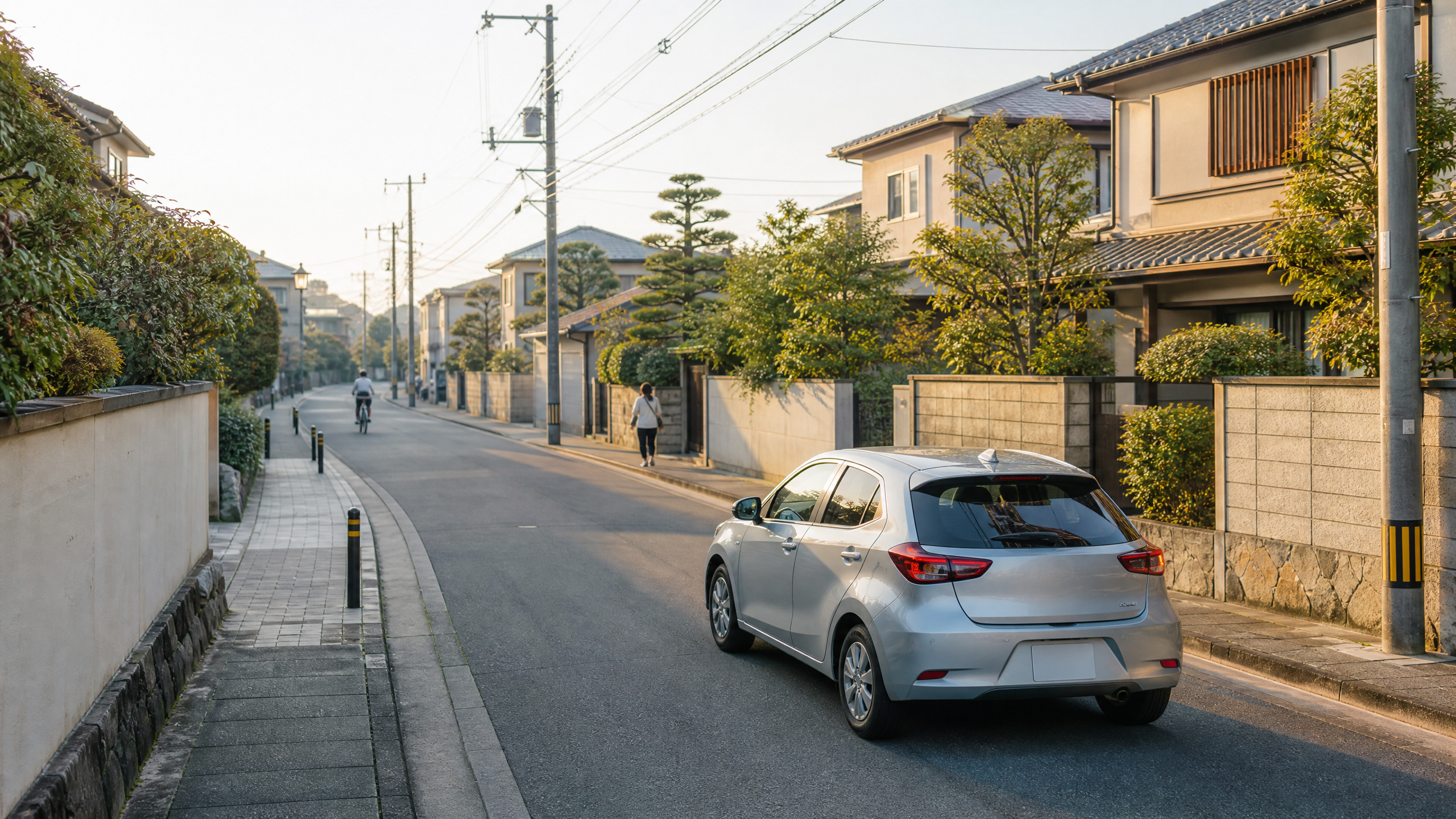
A new detail for your Japan driving plan
From 1 September 2026, Japan has changed the statutory speed for many residential roads, known in Japanese as seikatsu doro. For a visitor in a rental car, this is not a reason to memorise a new number and drive on autopilot. It is a prompt to look more carefully at the road in front of you. The National Police Agency explains that the statutory maximum on roads mainly used for residents’ everyday lives and without a centre line or lane markings is now 30 km/h, reduced from 60 km/h. The purpose is straightforward: these are the streets where people, bicycles, delivery vehicles and cars entering or leaving homes can appear close to the carriageway.
The change is useful to know before you leave an airport or city rental counter. Navigation may lead you from a broad arterial road into a quiet neighbourhood for a hotel, restaurant, parking facility or scenic stop. The road can feel informal, but it is still a public road with rules. Give yourself a little extra time rather than treating the last few kilometres as a race against a reservation or sunset.
What the 30 km/h statutory speed does—and does not—mean
The official guidance does not say that every road in Japan has become a 30 km/h road. It describes the changed category as general roads that are primarily used for local daily life and that do not have a centre line or designated traffic lanes. As examples of general roads that remain in a 60 km/h statutory category, the guidance lists roads with a centre line or traffic lanes and roads where traffic in opposite directions is separated by a median or similar structure. Motorways and automobile-only roads are also separate categories.
For a driver, the practical lesson is to avoid guessing from the name of a district, the type of building, or a route-app colour. Look at the road structure, then look again for signs and pavement markings. The police guidance makes one rule especially clear: when a maximum speed is specified by a road sign or road marking, that posted speed is the maximum that applies. A signed 40 km/h road can therefore remain 40 km/h even where the surrounding streets are quieter, while a signed 30 km/h limit must be followed even on a road that otherwise belongs to a different statutory category.
A calm rental-car routine for local streets
Use this short routine whenever the journey leaves a main road. It helps you apply the rule without trying to make a legal classification while moving.
- Before turning in: reduce speed early and scan for the speed-limit sign, road markings, pedestrians and cyclists.
- On a narrow local street: expect door openings, vehicles reversing from driveways and people stepping out from behind parked cars or walls.
- At every bend or junction: slow enough to stop within the distance you can actually see. A legal maximum is not a promise that the road is clear.
- When following navigation: check the screen only when safely stopped or with a passenger’s help; do not let a missed turn rush your next decision.
- When the road feels unfamiliar: choose patience. Continue slowly, find a lawful place to pull over if needed, and confirm the route before proceeding.
Why the sign still comes first
Visitors sometimes think of a statutory speed as the default speed to aim for. That is not the safest reading. The National Police Agency also states that drivers should choose a safe speed after considering road and traffic conditions, weather and visibility, even when travelling within the stated limit. On a wet street, beside a school entrance, around a blind curve, or where pedestrians are close to the roadway, an appropriate speed can be well below the maximum. Keep a generous gap from the vehicle ahead and avoid abrupt braking that surprises drivers behind you.
Do not use the 30 km/h rule to make assumptions about parking, access restrictions or one-way travel. Those questions are controlled by their own signs and markings. Read each sign at the location, follow directions from staff where you are entering private parking, and never stop where doing so would block a narrow road.
Make room for the last kilometre
A relaxed final approach is one of the simplest ways to make a self-drive day safer. Build a few minutes into your plan for local streets, keep your focus on road signs rather than an arrival estimate, and let local road conditions set your pace. Before each trip, check the latest official information; for this rule, start with the National Police Agency guidance. In Japan, the best rental-car route is not just the fastest one—it is the one you can finish calmly and safely.