

Japan Parking Rules Guide for Rental Car Drivers
Understanding Parking Rules in Japan: A Guide for Rental Car Drivers
Parking in Japan can be one of the more challenging aspects of a self-drive trip, especially for first-time visitors. Japan's road traffic laws are strictly enforced, and even a brief stop in the wrong location can result in a substantial fine. Understanding where you can and cannot park — and how to use the various types of parking facilities — will help you travel with confidence.
Parking vs. Stopping: An Important Legal Distinction
Japanese traffic law draws a clear distinction between "parking" (駐車, chūsha) and "stopping" (停車, teisha). Parking refers to leaving a vehicle unattended or remaining stationary for an extended period, including any situation where the driver has left the vehicle and cannot move it immediately. Stopping covers brief halts such as picking up or dropping off passengers, or pausing for five minutes or less to load goods. This distinction matters because the prohibited zones and penalties differ for each category.
Where You Cannot Park or Stop
Under Article 44 of Japan's Road Traffic Act, both parking and stopping are prohibited in the following locations:
- Intersections and within 5 metres of the edge of an intersection
- Pedestrian crossings and within 5 metres of their edges
- Railway level crossings and within 10 metres of their edges
- Bus stops and tram stops, within 10 metres of the stop marker
- Inside tunnels and near the top of steep hills
Article 45 additionally prohibits parking (though brief stopping may be permitted) near locations marked with a no-parking sign, within 3 metres of a garage entrance, within 5 metres of a fire hydrant, and within 1 metre of a fire alarm box. Parking on the same stretch of road for 12 hours or more during the day, or 8 hours or more overnight, also constitutes a violation.
Types of Coin Parking Lots
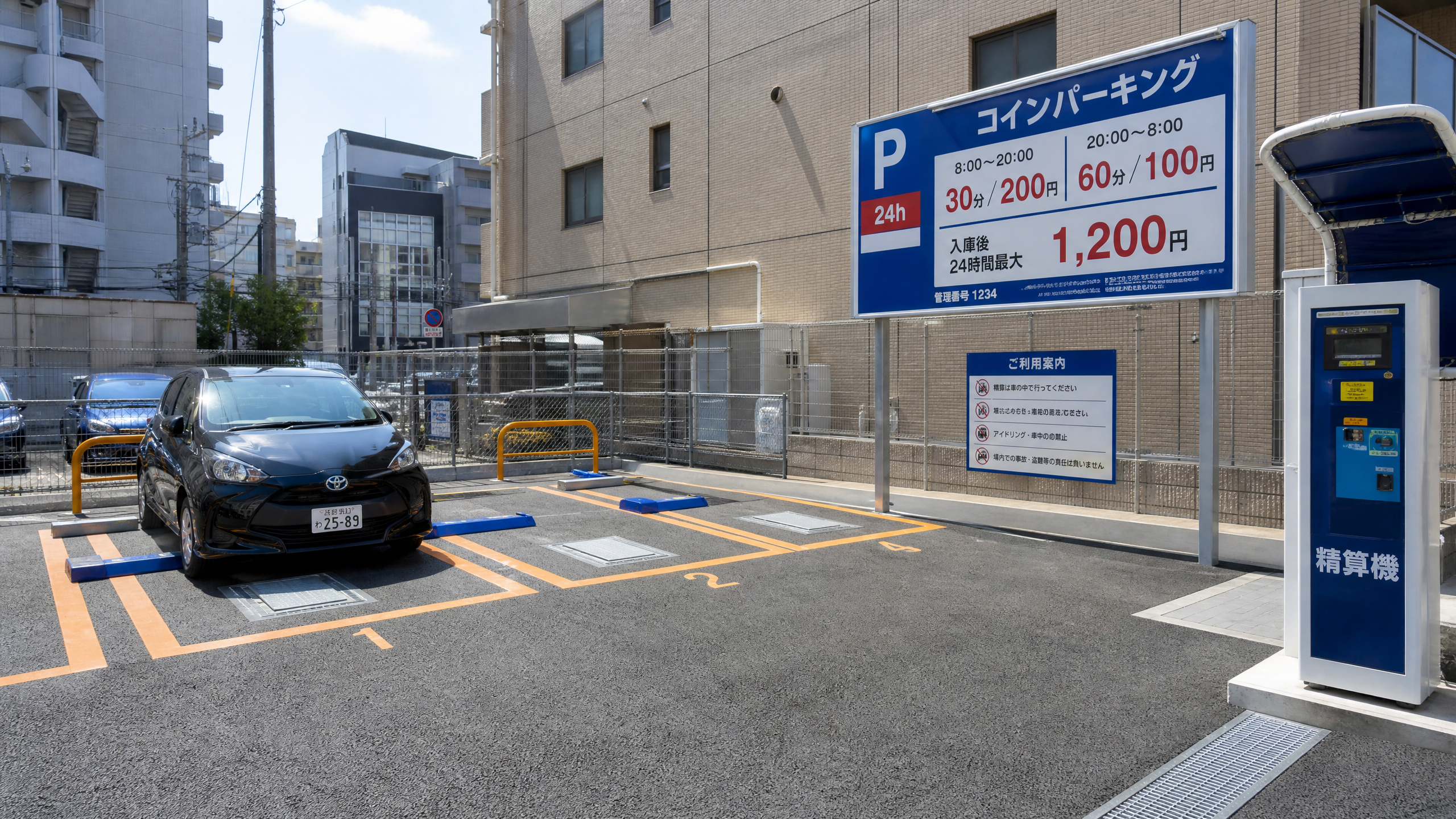
Japan has a well-developed network of paid parking facilities known as coin parking (コインパーキング). There are three main types you will encounter.
The most common in urban areas is the lock-plate type. After you drive into a numbered space, a metal plate rises beneath the vehicle to prevent it from leaving. To exit, go to the payment machine, enter your space number, press 精算 (seisan, meaning "settlement"), and pay the fee. Once payment is confirmed, the plate lowers. Always confirm the plate is fully down before moving, and depart promptly after paying.
The gate type is typically found at shopping centres and large facilities. You collect a ticket at the entrance gate and pay at the exit gate or a pre-payment machine inside. Many commercial facilities offer free or discounted parking when you make a purchase, so keep your ticket and ask at the service counter.
The prepaid or camera-based type is more common in suburban and tourist areas. In prepaid lots, you purchase a time ticket at the machine and place it on your dashboard. In camera-based lots, your licence plate is recorded on entry and you pay before leaving. These lots often offer lower rates and longer maximum stay periods.
Fees, Payment, and Practical Tips
Parking fees vary considerably by location. In central Tokyo, rates can exceed 500 yen per 10 minutes, while suburban lots may charge around 200 to 300 yen per hour. Most lots display both an hourly rate and a maximum daily fee (最大料金, saidai ryōkin). Be aware that the daily maximum often differs between daytime and overnight periods, so read the rate board carefully.
Payment machines generally accept 1,000-yen notes and coins. Many modern lots also accept credit cards and IC cards such as Suica or Pasmo. Five-thousand-yen and ten-thousand-yen notes are typically not accepted, so carry smaller bills. At the entrance, watch for the signs: 空 (kū) means vacant spaces are available, while 満 (man) means the lot is full.
Penalties for Violations
If your rental car is found illegally parked while you are absent, it is classified as an abandoned vehicle violation (放置駐車違反). Fines for a standard passenger car are 15,000 yen in a no-parking zone and 18,000 yen in a no-stopping zone. Rental companies typically pass these fines to the renter, often with an additional handling fee. Planning your route in advance and using a parking search app such as Times Parking or Park24 to locate a designated lot near your destination is the most reliable way to avoid these penalties.