

Japan’s Narrow Roads: A Calm Rental-Car Passing Plan
Why narrow roads need a different plan
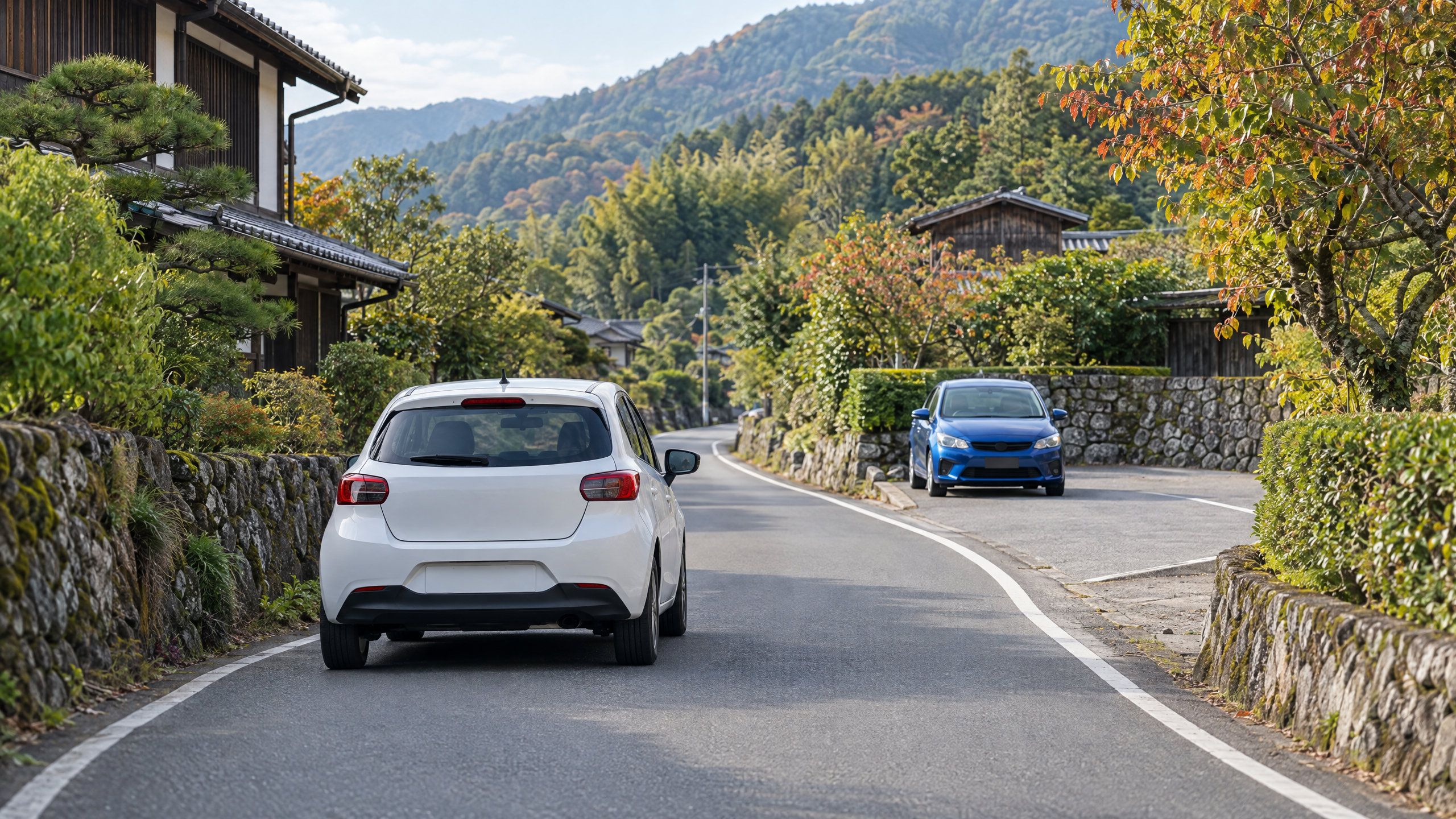
A rental-car trip in Japan can move quickly from a broad main road to a lane with no centre line. This is common around residential streets, rural settlements, scenic viewpoints and smaller attractions. The challenge is not to prove that you can keep moving. It is to leave enough time and space to make calm decisions when an oncoming car, a pedestrian or a cyclist appears. Japan Automobile Federation guidance emphasises keeping left, giving pedestrians priority and avoiding distraction from a phone or navigation screen. Those habits matter even more when the road is too narrow for two vehicles to pass comfortably.
Before the wheels get close to an edge, reset the goal: arrive without rushing. Do not treat a navigation shortcut as a promise that the road will suit every driver or every vehicle. If a route becomes uncomfortable, it is reasonable to slow down, find a safe place to turn or return to a wider road.
Prepare before you enter the small streets
Good decisions are easier before the road narrows. At the rental counter, take a minute to understand the car’s width, mirrors, reverse camera and parking sensors. Set the destination and any next stop while parked. In Japan, using a phone while driving or focusing on the navigation screen is not acceptable; pull over legally and safely before changing the route.
- Choose a vehicle size that suits your passengers and luggage without taking more space than your trip needs.
- Review the final approach to your accommodation, car park or attraction, rather than looking only at the long-distance route.
- Allow extra time for a slower final few kilometres, especially after dark or in rain.
- Keep the rental company’s contact details available in case you need route or vehicle help.
Road signs and road markings set the applicable speed limit. On a narrow road, the posted limit is not a target to reach. Reduce speed further whenever sightlines, surface conditions or other road users call for it.
When an oncoming vehicle appears
Look well ahead, not only at the bonnet. You may spot an approaching car, a delivery vehicle, a pedestrian or a bicycle before the space becomes tight. Ease off the accelerator early and look for a safe, clearly visible widening, lay-by or entrance that is genuinely suitable for stopping. Do not mount a kerb, enter a pedestrian space or force a pass beside a blind bend simply to avoid waiting.
- Signal your intention early if you are moving into a safe place to wait.
- Stop fully if needed and leave the other driver room to complete the pass.
- Use the car’s mirrors and camera as aids, while still checking directly around the vehicle.
- Keep your steering smooth and your attention outside the car; do not let a passenger’s directions distract you.
There is no prize for squeezing through. If the available space is uncertain, wait. A few quiet seconds are safer than a scrape with a mirror, a wall or a parked vehicle.
If you must reverse, make it deliberate
Sometimes the safer choice is to reverse to a wider point. First stop, secure the car and assess where you can go. Check behind and around the vehicle, use the mirrors and camera, and reverse slowly only as far as necessary. A passenger can help by watching from a safe location if this can be done without stepping into traffic. If you cannot reverse safely, do not improvise. Stay calm, use hazard lights only when appropriate to warn other road users, and contact the rental company if you need assistance.
At a stop sign, make a complete stop and check both directions before proceeding. The same calm observation helps on every constrained road: pedestrians have priority, traffic keeps left, and your next movement should be one you can complete safely.
Build space into the day
Narrow local roads are part of the character of many Japanese destinations, not a failure in your plan. Schedule fewer fixed-time stops, avoid arriving at an unfamiliar rural address at the last minute, and give the driver permission to choose the wider route. With the route set while parked, the speed kept modest and a safe waiting place chosen early, a narrow road becomes a manageable part of the drive rather than a stressful surprise.